What great incentive plans have in common
An incentive plan is one of the clearest messages a company sends its sales team. It describes what matters organizationally, what success looks like, and how the company will share in that success. When a plan is built well, reps know exactly where to focus, leaders see the results they planned for, and Finance can forecast the cost with confidence.
Getting there brings a lot of voices to the table. Leadership sets the direction. Finance needs a cost it can plan around. Sales leaders want a plan their teams will get excited about. The comp administration team needs something the system can calculate accurately and on time. The best plans give each of those perspectives a place in the design while keeping the plan coherent as a whole.
At Blue Horizons Group (BHG), we work with organizations across industries on incentive plan design, and the strongest plans we see share a common approach. They are built with modeling and motivation in mind from the very first decision.
We think every incentive plan should pass three tests before it ever reaches a rep:
- Is it good design? Does it reflect what the business actually needs, and is it built so it can be modeled, administered, and explained?
- Does it motivate? Will it give reps a real reason to do more, at every point in the year and at every level of performance?
- Does modeling show it produces the results the business needs? When you run real and simulated performance through the plan, do the payouts and costs land where you expect?
This article focuses on the first two tests. We walk through ten design considerations that shape every incentive plan, with a practical tip for each one that makes the plan easier to model later. Then we cover eight ways to check what we call the plan’s motivational quotient: whether it will actually change behavior, not just pay people.
The common thread is intent. When each design decision is made with testing and motivation in mind, the plan that reaches reps is one everyone can stand behind: clear to the sales team, predictable for Finance, and built to deliver what the business set out to achieve.
Part one: ten design considerations
The ten considerations below cover the full anatomy of an incentive plan, from the strategy it serves to the governance that keeps it running. They are roughly sequential: early decisions set the reference points that later decisions depend on. For each one, we describe what to think about and offer one model-ready tip, a habit that makes the plan far easier to test before launch.
1. Start with the business strategy
The first question is not “what did we pay on last year?” It is “what behaviors and outcomes are important to the company this year?”
That answer should come from the business plan, not the comp plan. Is the priority new logos or retention of existing accounts? Revenue growth or margin? Broad product sales or a push on a specific product line?
Starting from last year’s plan is tempting because it feels efficient. But a plan built by editing the previous version tends to carry forward measures, mechanics, and exceptions that made sense for a business that no longer exists. So: strategy first, then design.
Model-ready tip: Write the expected outcomes down as testable statements. For example: “A rep at 100% of goal earns target incentive. The top 10% of performers earn 2 to 3 times target.” Statements like these feel like a formality at the design stage, but they become your pass/fail criteria later. When you model the plan, you are no longer asking whether the results “look reasonable.” You are checking them against a standard everyone agreed to in advance.
2. Role clarity and eligibility
Next, decide who is on the plan and what their actual sales influence is.
This sounds obvious, but eligibility is where many plans get muddy. Over time, organizations add roles to incentive plans for reasons that have little to do with sales influence: a manager advocated for their team, a role changed but its plan didn’t, or a new hire negotiated eligibility during recruiting. The result is a participant population with very different levels of influence over the outcomes being measured, all sharing plan mechanics that only make sense for some of them.
Work through three questions for every role:
- Should this role be on an incentive plan at all?
- Sales influence. How directly does this role affect the outcome being paid on? A quota-carrying account executive and a sales engineer both contribute to a deal, but in very different ways.
- Plan structure. Does this role need its own plan, or can it share one with a similar role?
Model-ready tip: Build a clean participant roster early. At minimum, it should include role, plan assignment, territory, hire date, tenure, and target incentive for every person. This roster is the backbone of every model you will run. If it is incomplete or inconsistent, every result downstream inherits the problem, and you will spend your modeling time cleaning data instead of testing the plan.
3. Total cash compensation
Before deciding how to split pay between base salary and incentive, decide what each role should earn in total at target performance.
Target total cash compensation is base salary plus target incentive. Setting it starts with market pricing for each sales role, then a decision about competitive positioning. Does the company want to pay at the market median for this role, or above it to attract talent in a tight market? It also requires a look at internal equity, so that roles at similar levels with similar impact are paid consistently.
The order matters. When companies start with pay mix (“our reps are 60/40”) and back into total cash, they can end up with targets that are out of step with the market in either direction. Starting with total cash keeps the plan anchored to what the role is actually worth.
Model-ready tip: Set target total cash by role before you decide the pay mix. That way, every model you build starts from a market-validated number rather than an assumption that might shift halfway through the process.
4. Pay mix and leverage
With target total cash set, the next decision is how to divide it. Pay mix is the split between base salary and target incentive. Leverage is the upside: how much more than target incentive a strong performer can earn.
Two factors should drive both decisions by role.
- Sales influence. The more directly a role controls the sale, the more of its pay should be at risk. A hunter who sources and closes new business warrants a more aggressive mix than an account manager whose revenue is largely driven by an installed base.
- Sales cycle. Long, complex sales cycles with large deals often call for a more conservative mix, because a single slipped deal can swing a rep’s year. Shorter cycles with steady transaction volume can support more variable pay.
Model-ready tip: Lock target incentive and leverage for each role before you start modeling. If those numbers keep moving, you are never testing the mechanics against a fixed reference point, and it becomes impossible to tell whether a change in modeled cost came from the mechanics or from a shifting target.
5. Measures and weights
This is where many plans get into trouble, usually by trying to do too much. Our guidance is two or three measures, maximum, each with a clear weight.
Every measure on the plan should pass three checks:
- It is controllable. The rep can meaningfully influence the result.
- It is meaningful. It reflects something the business actually cares about this year.
- It is tracked in a system of record. If the data lives in someone’s personal spreadsheet, it will create disputes.
Each measure then carries a weight: its share of the target incentive. For example, a plan might weight revenue at 60% and new logos at 40%. Weights should reflect business priority, and every measure needs to be weighted heavily enough to get attention. A measure worth 5% of target incentive is effectively invisible. Reps will rationally ignore it, and you will have added complexity to the plan without changing any behavior.
The pull toward more measures is constant. Every stakeholder has a priority they would like the plan to reinforce. But each new measure dilutes the others, makes the plan harder to explain, and adds data that needs to be sourced, validated, and calculated. If a priority truly matters, it may be better served through a SPIF, a gate, or a separate program.
Model-ready tip: It helps if your measures have clean historical data, but business strategy is the ultimate decider. Set weights up as inputs in your model rather than hard-coding them, so you can easily test alternate splits. If a measure is new and has no history, circle back with the individuals who set the corporate strategy. They relied on information to set that strategy; use that as your proxy and flag it clearly as an assumption.
6. Payout mechanics
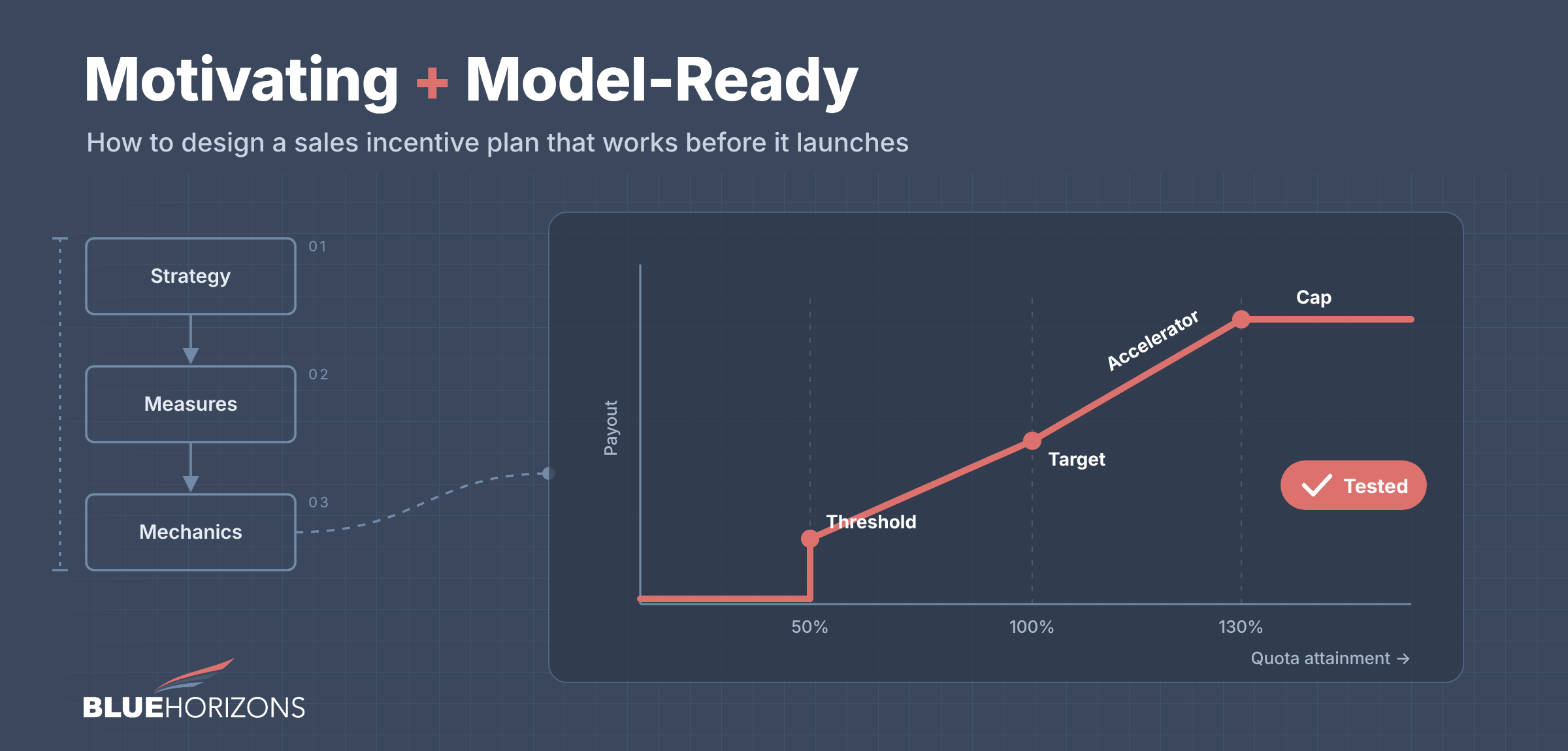
Payout mechanics are the machinery that turns performance into pay. Popular components are:
- Thresholds: the minimum performance level before any incentive is earned.
- Accelerators and decelerators: rate changes above or below certain performance levels, which reward overachievement and reduce payout for underperformance.
- Caps: limits on the maximum payout, either on a measure or on the plan as a whole.
- Linked vs. unlinked components: whether performance on one measure affects the payout on another. Linked components encourage balanced performance. Unlinked components let each measure stand on its own.
- Gates and modifiers: conditions that must be met before a payout is earned (a gate) or that adjust the payout up or down (a modifier), such as a margin requirement or a customer satisfaction multiplier.
Each of these is a legitimate design tool. The risk is combining too many of them, which produces a plan that behaves unpredictably and that no rep can explain. Every mechanic should earn its place by solving a specific problem.
Model-ready tip: Keep mechanics formulaic and parameterized. Discretion can’t be modeled. If a plan says a manager “may adjust” a payout based on judgment, there is no way to predict what that will cost or how reps will respond to it. Where judgment truly is needed, handle it through a documented exception process (more on that under governance), not inside the plan formula.
7. Crediting rules
Crediting rules decide who gets credit for a sale, and when. They rarely get the attention they deserve during design, and they are one of the biggest sources of disputes once a plan is live.
The common scenarios to address include:
- Splits: how credit is divided when more than one rep works a deal.
- Overlays: specialists or managers who receive credit on top of the primary rep.
- House accounts: accounts that are not assigned to any rep, and whether anyone earns credit on them.
- Channel credit: how sales through partners or resellers are credited to direct reps.
- Mid-period territory changes: what happens to credit when accounts move between reps partway through a performance period.
Wherever possible, crediting should be assigned systematically, based on data in your CRM or system of record, rather than determined case by case. Manual crediting decisions are slow, hard to audit, and easy to perceive as unfair.
Model-ready tip: Write crediting rules in plain language before you model. Pay particular attention to overlay and double-credit roles. When multiple people earn full credit on the same revenue, the cost of sales can climb well beyond what the plan’s headline rates suggest.
8. Timing and cash flow
Timing decisions determine when performance is measured and when it is paid. The key elements are:
- Performance periods: monthly, quarterly, annual, or a combination.
- Payment frequency: how often incentive is paid out.
- True-ups: how and when payments are reconciled against full-period results.
- Draws and clawbacks: advances against future earnings, and the recovery of payments when a deal cancels or a customer doesn’t pay.
- New hire ramps: reduced or guaranteed targets while new reps build a pipeline.
Timing affects both motivation and cash flow. A rep on an annual plan with a single payout in February has a much weaker connection between effort and reward than a rep paid monthly. On the other hand, frequent payments on long-cycle deals can lead to overpayments that require painful clawbacks later.
Model-ready tip: Model by period, not just annually. An annual cost that looks perfectly acceptable can still create a painful Q4 accrual if the payout curve concentrates earnings at year end. Running the model month by month or quarter by quarter shows Finance exactly when the money goes out, not just how much.
9. Affordability and cost of sales
Every incentive plan is an investment, and it should be evaluated like one. The core questions are:
- Total incentive cost: what the plan will cost at expected performance, and at higher and lower performance.
- Cost of sales as a percentage of revenue: whether the plan is affordable relative to the revenue it generates.
- Return at various performance levels: whether the incremental revenue from overperformance justifies the incremental payout.
The last point is often overlooked. A plan can look affordable at target and still become expensive at high attainment, especially if accelerators are steep and uncapped. Conversely, a plan that is too conservative at the top may save money on paper but cost the business the extra effort from its strongest performers.
Model-ready tip: Agree on cost guardrails with Finance up front. Settle on the acceptable range for total incentive cost and cost of sales before modeling begins, so the model has a clear target to hit or miss.
10. Governance and administration
The final consideration is what we call the rules around the rules. Even a well-designed plan needs a framework for handling the situations it doesn’t address directly. That framework should include:
- SPIF policy: when short-term incentives are appropriate, who approves them, and how they interact with the core plan.
- Windfall provisions: how the company will handle unexpectedly large deals that were not the result of the rep’s effort.
- Exception process: who can approve exceptions, how they are documented, and how they are tracked.
- Plan change controls: under what circumstances the plan can be changed mid-year, and how changes are communicated.
- System capability: whether your incentive compensation management (ICM) platform can actually calculate what you designed.
That last item deserves emphasis. We regularly see plans designed in a conference room that the ICM platform cannot calculate without custom workarounds or manual adjustments. Every workaround adds administrative effort, introduces error risk, and slows down payments.
Model-ready tip: Bring the comp admin or ICM team into the design process early. If a plan can’t be calculated cleanly in the system, it can’t be modeled reliably either. The people who will administer the plan are often the first to spot a mechanic that looks simple on a slide but becomes complex in practice.
Part two: checking the motivational quotient
A plan can be affordable and accurate and still not move anyone.
That is the uncomfortable truth behind many incentive plans. They pass Finance’s review, the ICM team can calculate them, and the payouts come out correctly every period. But reps don’t sell any differently than they would have without the plan. The company is paying for behavior it was going to get anyway.
Before launch, it is worth testing whether the plan actually gives reps a reason to do more. We call this checking the plan’s motivational quotient. The eight tests below can be run with a draft plan, a spreadsheet, and a few conversations. None of them require a sophisticated model, and together they catch the most common motivational failures before reps ever see the plan.
Test 1: The one-sentence test
Can a rep explain how they get paid in a sentence or two after reading the plan once? If not, line of sight is broken.
Line of sight is the connection a rep sees between their daily activity and their paycheck. When a rep understands that closing one more deal this month means a specific, predictable payout, the plan is doing its job. When the plan requires a calculator, a glossary, and a call to the comp team to interpret, reps stop trying to optimize for it. They just sell and hope the check is right.
To run the test, hand the draft plan document to three reps or a sales manager. Ask them to read it once and then explain, in their own words, how they would get paid. Listen for hesitation, confusion, or explanations that don’t match what you designed.
In our experience, plans with more than three measures almost always fail this test. So do plans with multiple interacting mechanics, such as a gate, a modifier, and a linked accelerator all affecting the same payout. If the explanations you hear are inaccurate, simplify the plan before you change anything else.
Test 2: The “next deal” test
Price out what a typical deal pays a rep at three points in the year: at 50% of quota, at 100%, and at 130%.
This test checks two things. First, is the payout on the next deal noticeable? If a typical deal adds a trivial amount relative to a rep’s monthly pay, the plan won’t change behavior. Reps will make rational choices about where to spend their time, and a payout that barely registers will not win that competition.
Second, does the payout change as performance improves? If a rep earns the same amount on a deal whether they are at 50% or 130% of quota, either the plan has no accelerator or the one it has never reaches the rep. The purpose of an accelerator is to make the next deal more valuable as a rep climbs. If that difference is not visible on a single deal, reps will not act on it.
Test 3: The attainability test
Estimate how many reps will reach threshold and how many will reach quota under the new plan.
If threshold is out of reach for a large share of the sales population, you have built a plan that writes off part of the team in February. Reps who conclude early in the year that they will not earn any incentive have little reason to push, and some will start looking for a job with a plan they believe they can win with.
A commonly cited healthy range is roughly half to two-thirds of reps at or above quota. That figure is a useful starting point, but the most reliable benchmark is your own history. Use past attainment data to estimate how the new thresholds and quotas will land across the population, and adjust if too many reps fall below the line.
There are several ways to build this estimate, from a simple replay of last year’s results to a full simulation. We’ll walk through them in our next article on modeling your plan.
Test 4: The dead zone test
Map every point in the year and on the payout curve where additional effort stops paying.
Dead zones are the stretches where the plan stops motivating. They typically show up in three places:
- Far below threshold. A rep so far behind that reaching threshold looks impossible has no incentive to keep pushing.
- Above a cap. Once a rep hits the cap, every additional deal earns nothing, so the rational move is to delay deals into the next period.
- After a quarterly goal is secured. If a rep has locked in the quarter’s payout and the next quarter starts fresh, deals tend to slip across the boundary.
Some dead zones are deliberate trade-offs. A cap may be necessary for budget certainty, for example. But each one should be a conscious choice, made with a clear understanding of the behavior it will create.
Test 5: The top performer test
Your best people should earn meaningfully more than your average performers, often 2 to 3 times target incentive.
Top performers are the most valuable people on the sales team and, usually, the most marketable. They know what they are worth, and they pay close attention to how the plan treats exceptional results. A flat top end, whether from a low cap, weak accelerators, or decelerators that kick in too early, gets noticed by these reps first.
To run this test, model the payout for your actual top 10% of performers from last year under the new plan. Compare what they would earn to what an average performer would earn. If the gap is small, the plan is sending a clear message to your best people: extra effort is not worth much here. That message is expensive, because replacing a top performer costs far more than paying one appropriately.
This test connects directly to the testable statements from the first design consideration. If you noted that the top 10% should earn 2 to 2.5 times target, this is where you confirm the plan delivers it.
Also: it’s worth questioning whether the highest-paid reps are actually the best sales reps. Work with your sales leadership to identify high-performing reps and correlate that evaluation with payout. The answer may surprise everyone.
Test 6: The timing test
Compare the plan’s payment frequency to the sales cycle. As a general rule, pay as close to revenue realization as you can.
The longer the gap between a rep’s effort and the reward, the weaker the connection between them. A rep who closes a deal in March and is paid on it the following February will struggle to feel that the payout was tied to that specific win. A rep paid the following month feels it immediately.
The right frequency depends on the sales cycle. For transactional sales with short cycles, monthly payouts often make sense. For complex, long-cycle sales, quarterly payments with an annual true-up may be more practical. The goal is to keep the reward close enough to the result that reps experience them as connected, without creating overpayments that need to be clawed back later.
Test 7: The controllability test
For every measure on the plan, ask: can the rep meaningfully influence this result?
Measures driven by factors outside a rep’s control erode motivation fast. Common examples include results that depend on pricing decisions made at headquarters, product availability or supply constraints, or large corporate accounts that buy on their own schedule regardless of the rep’s efforts.
When reps see their payout move up or down because of factors they cannot affect, two things happen: good results feel like luck rather than achievement, and bad results feel unfair. Neither outcome builds the kind of engagement a plan is supposed to create. This test echoes the controllability check under measures and weights, but it is worth running again from the rep’s point of view, since a measure that looks controllable from a planning spreadsheet may feel very different in the field.
Test 8: Ask them
The most direct way to understand how reps will respond to a plan is to ask them.
A short focus group or survey of reps and first-line managers on a draft plan surfaces confusion and perceived unfairness before it becomes turnover. You don’t need a large sample. A handful of thoughtful conversations with a mix of tenured reps, newer reps, and managers will reveal most of the issues.
Useful questions include:
- How do you think you would get paid under this plan?
- What would you do differently under this plan compared to the current one?
- Is there anything about this plan that feels unfair or confusing?
If you’re nervous about sharing a draft plan with active reps, engage with newly-promoted sales managers and ask for their views.
Bringing it together
The ten design considerations and the eight motivational tests are two sides of the same discipline. The design considerations make sure the plan is built on a sound foundation: anchored to strategy, priced to the market, affordable, administrable, and structured so it can be tested. The motivational tests make sure that foundation actually supports the behavior the business needs.
You will notice how often the two overlap. Controllability shows up in both. The top performer test checks the outcome statements written at the very start. The dead zone test depends on decisions about caps, thresholds, and timing. That overlap is the point. A strong plan is not a collection of individually reasonable decisions. It is a set of decisions that work together.
The model-ready tips also set up the third test every plan should pass: modeling. If you have written testable outcome statements, built a clean participant roster, locked targets and leverage by role, parameterized your mechanics, documented crediting rules, and agreed on cost guardrails with Finance, you are ready to put the plan through rigorous testing. Historical back-testing, scenario and sensitivity analysis, Monte Carlo simulation, payout curve and edge case testing, and stress testing each answer a different question about how the plan will perform. Each of those methods is worth exploring in depth on its own.
In the end, a strong incentive plan passes three tests before it ever reaches a rep:
- It’s designed with strong, tested principles.
- It gives people a reason to do more.
- The easiest way to earn more is to do what the business needs, a result supported by thorough modeling.
If any one of those fails, fix it in design. It only gets more expensive after launch.
Blue Horizons Group (BHG) is a platform-agnostic sales performance management (SPM) advisory and implementation firm. Our consultants help organizations design, model, and administer incentive compensation plans that drive results. To talk with our team about your next plan design, visit bluehorizonsgroup.com.