What Is Sales Performance Management (SPM)?
By Elizabeth Evans, CSCP, PMP, SPM Consultant at Blue Horizons Group
Sales performance management (SPM) is the connected set of processes, systems, and decisions that turns company strategy into sales behavior and then pays people for it. It spans executive intent, go-to-market design, compensation plan design, incentive compensation management (ICM), data, governance, and analytics. In most organizations, no single person owns all of it.
Who this is for: sales compensation administrators, Sales Operations and revenue operations (RevOps) leaders, finance partners, and VPs of Sales who own one piece of SPM and need to see how the rest of it works.
There is an old story about a group of blind men who meet an elephant for the first time. The one touching its side reports a wall. The one holding a leg reports a tree, and the one holding the trunk is certain it is a snake.
Sales performance management works the same way. Sales leadership sees quotas and territories. Finance sees accruals and cost of sales, HR sees plan documents and eligibility rules, IT sees integrations, and the comp administrator sees a payroll file due Thursday.
Based on our team's work across 300+ SPM and ICM implementations, that partial view is the rule, not the exception, and it explains more broken comp programs than any formula error. The comp administrator, for example, is usually responsible for the output of the process (and the cleanup after the output) without ever being the one who feeds it.
This post lays out what SPM actually includes, the three-layer framework Blue Horizons Group (BHG) uses to see the whole animal, and what to do when nobody in your organization is officially in charge of it. It draws on the first episode of Around the Spreadsheet, BHG's podcast for sales compensation practitioners.
What does sales performance management include?
Sales performance management includes every activity that connects what a company wants to achieve with how its salespeople are directed, measured, and paid. That covers strategy and go-to-market design, territory and quota setting, incentive plan design, commission calculation and payment, the data and rules that feed those calculations, and the analysis that tells leaders whether any of it worked.
The simplest test is to follow a single dollar of revenue. Somebody decided which market it came from, which role was supposed to sell it, what quota it counts toward, and what rate it pays. Somebody else credited it, calculated it, approved it, paid it, and reported on it. All of those people are doing sales performance management, whether or not their job titles say so.
How did SPM get its name?
The discipline has been renamed several times as its scope grew. In the early days it was simply sales compensation. It then became enterprise incentive management (EIM), then incentive compensation management (ICM), and finally sales performance management.
The names changed as the scope grew, but the goal did not: drive the right sales behavior through a well-built sales compensation program that connects company initiatives to how the sales force goes to market.
The renaming matters for one practical reason. Many organizations still treat sales comp as a payroll task, while their software vendors and consultants talk about SPM as an enterprise discipline. If your leadership hears "sales comp" and thinks "spreadsheet in accounting," you will have trouble getting budget for anything upstream of the payout.
How is SPM different from sales performance, sales effectiveness, and sales enablement?
These terms overlap, and the overlap causes real confusion in vendor evaluations and org design. Here is how we separate them:
Term | What it is | What it covers | Question it answers |
Sales performance | The outcome | Revenue, margin, attainment, and the other numbers the business reports | How did we do? |
Sales effectiveness | The quality of selling | Win rates, pipeline conversion, deal size, and the rep behaviors behind them | How well are we selling? |
Sales enablement | The support that helps reps sell | Training, content, tools, and coaching | Do reps have what they need to sell? |
Sales performance management (SPM) | The system that directs and rewards performance | Territories, quotas, plans, crediting, calculation, payment, governance, and the analytics that close the loop | Are we directing and paying for the results the business needs? |
A lot of what gets published about SPM drifts into enablement and effectiveness. Those disciplines matter, but at the end of the day SPM is about how you pay the sales reps and whether that pay is driving what the business needs.
Why is sales performance management so hard to see all at once?
Sales performance management is hard to see as a whole because each stakeholder touches only the part that lands on their desk. Sales, Sales Operations, finance, HR, payroll, and IT each own a slice of the process, and each slice looks complete from the inside.
This is the elephant problem. Nobody is wrong about what they are touching. The trouble starts when each group makes decisions as if its piece were the whole animal.
What the comp administrator sees
The administrator usually sits at the end of the process. Data arrives, rules get applied, statements go out, and disputes come back. When something upstream was decided badly (a territory carved without clean account data, a quota set without a capacity model), the administrator inherits the consequence without having been in the room.
Many practitioners first see sales comp from this side of the house, as a matter of getting people paid for what they sold. The longer they work in it, the more of the elephant comes into view, and the more of the trouble they can trace upstream.
The iceberg below the attainment number
In sales performance management, attainment is the tip of the iceberg: the number everyone looks at. Everything that actually sinks the ship sits below the waterline.
- Below the waterline you find the things that rarely make it into an executive update:
- Hierarchy and territory data that is out of date by the time the plan year starts.
- Crediting rules that live in one person's head.
- Plan documents that say one thing while the calculation engine does another.
- Exceptions approved by email and never recorded.
- Disputes that get resolved one at a time without anyone asking why they keep happening.
Organizations steer around the visible tip and hit the mass underneath. The only fix is a model that makes the hidden parts visible, which is what a framework is for.
What is the BHG SPM Framework?
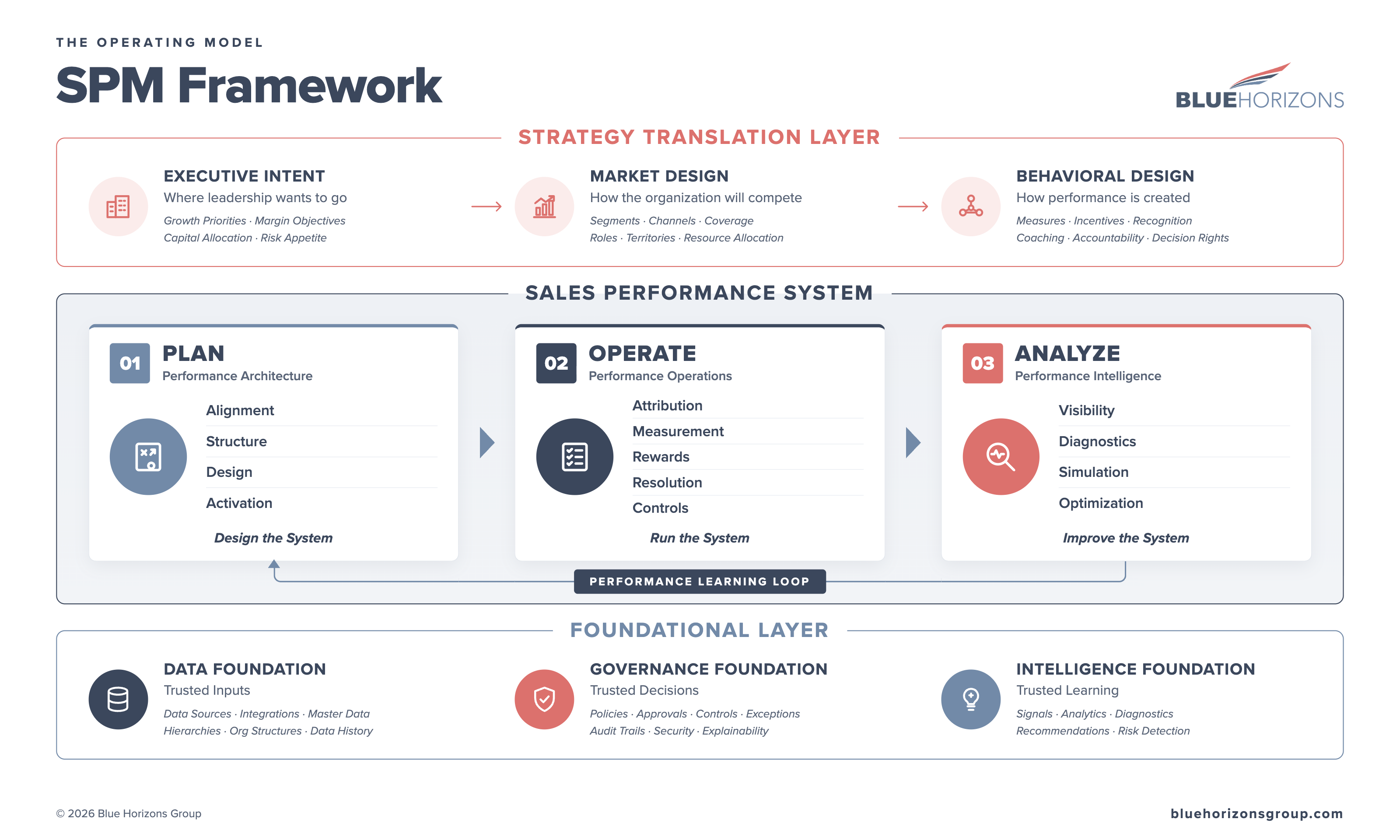
The BHG SPM Framework organizes sales performance management into three layers: a strategy translation layer, a sales performance system, and a foundational layer. Strategy flows down through the layers into pay, and what the business learns from results flows back up to inform the next round of decisions.
The framework's value is that you can share it with stakeholders on day one and have a shared picture of the whole elephant before anyone argues about a single rate table.
Layer 1: The strategy translation layer
The strategy translation layer answers two questions: what is the company trying to do, and how will the sales organization get it there. It has three parts.
- Executive intent. What leadership at the C-level and the board has committed to, including what the CEO told investors on the last earnings call.
- Market design. The go-to-market motion: segments, channels, coverage models, and which roles sell what to whom.
- Behavioral design. The people side: the measures, incentives, and recognition programs that turn the go-to-market plan into specific selling behavior.
This is where comp plan design best practices start, well before anyone opens a plan template. A plan can only reinforce a strategy that has been translated into roles and measures first.
Layer 2: The sales performance system
The sales performance system is where strategy becomes action, and it is most of what sits below the waterline. It runs in three motions.
- Plan. Territories, quotas, plan design, and modeling for the coming period.
- Operate. The day-to-day work of crediting, calculating, approving, and paying, usually run on an ICM platform such as Varicent, Xactly Incent, or CaptivateIQ.
- Analyze. Looking back at what the plans actually produced, measuring cost against results, and feeding improvements into the next planning cycle.
Most organizations invest heavily in Operate because that is where the payroll deadline lives. Plan and Analyze get whatever time is left, which is how the same problems repeat year after year.
Layer 3: The foundational layer
The foundational layer holds the capabilities that everything above depends on. If it is weak, the best plan design in the world will still pay the wrong people the wrong amounts. It has three foundations.
- Data foundation. Trusted, integrated, current source data: transactions, hierarchies, org structures, and the master records that tie them together. In SPM, you live and die by data.
- Governance foundation. How decisions about plans, exceptions, and disputes get made, documented, and enforced. Many companies say they have governance; far fewer enforce it consistently.
- Intelligence foundation. Analytics has always been part of SPM. What has changed is AI, which is moving this foundation toward reading signals and telemetry, diagnosing issues, recommending changes, and flagging risk before it turns into a missed payout or a missed number.
The foundations are also where ICM projects tend to break. Based on our consultants' remediation work across 300+ SPM implementations, a failed implementation typically costs one to three times the original budget to fix, and the root cause is usually a data or governance gap that was visible before the software was ever configured.
How the three layers work together
The layers are a loop, not a staircase. Executive intent shapes market design, which shapes behavioral design, which drives how plans are built and paid. The Analyze motion and the intelligence foundation then push what was learned back up to the people who set strategy.
When that loop works, the sales compensation function stops being a reactive group buried in disputes. It becomes a center of excellence that gets ahead of problems and gives leadership information it can act on.
Who owns sales performance management?
In most organizations, nobody owns sales performance management end to end. Its pieces are split across sales leadership, Sales Operations or RevOps, finance, HR, payroll, and IT, and each group owns its part of the process without a mandate over the whole.
Ask who owns SPM end to end, and the answer is almost always the same: there is never one person. In many organizations it is hard to find anyone who knows SPM exists as a discipline, because the work is being done on a spreadsheet by someone down the hall. Even some CFOs are surprised to learn SPM is a category at all.
Why the ownership gap matters
The gap matters because the decisions with the biggest consequences are made furthest from the people who pay for them. Quotas, territories, and role definitions are usually set in sales strategy or finance. The comp team inherits those decisions and has to make them calculate, often without knowing who made them or why.
The structure is also shifting. Many companies have moved from traditional Sales Operations teams to RevOps organizations reporting to a chief revenue officer (CRO). Legacy industries in the middle of a transformation look different again, and smaller companies often have one person wearing four hats.
Some organizations bring in contractors to build plans during the planning cycle, then run those plans for a year before repeating the exercise. That works until a mid-year question comes up and the people who designed the plan are gone.
Someone has to step up
If no one is formally in charge, someone who owns a piece of the process has to lead without the title. That means taking responsibility for whether the whole elephant gets fed, not just whether your part of it shows up on time.
This takes some nerve. The person who steps up will occasionally have to tell a peer in another department that their part of the process is breaking someone else's. Done well, it is the single most valuable thing a leader can do for the program.
How do you identify the stakeholders in your SPM process?
Start by mapping real names to every part of the framework. Take the framework and try to name at least six people who operate against it. If you can't, you have found your first project.
- List the operational contacts you already know. Most comp teams can name their data providers, payroll contacts, HR partners, and finance partners without thinking.
- Work upstream to the strategy layer. Find out who defines territories, who sets the overall quota number, who decides role definitions and segments, and who signs off on plan design.
- Follow the disputes. When you don't know who owns a piece, ask yourself who you call when someone isn't paid correctly. That person very often knows the answer.
- Check the sales channels. Channel and partner teams frequently hold crediting and coverage knowledge that never makes it into a process document.
- Write it down and share it. A one-page stakeholder map tied to the framework becomes the starting point for governance, change management, and any future ICM project.
This is the same discipline any enterprise program needs, whether it is an enterprise resource planning (ERP), human capital management (HCM), or customer relationship management (CRM) rollout. You have to know where all the bodies are buried, starting with where your data comes from.
What happens when your comp plan doesn't match corporate strategy?
When a comp plan doesn't match corporate strategy, reps do exactly what the plan pays for, and the company misses the goals it actually announced. The calculation can be perfectly accurate and still drive the wrong results.
If executive intent is out of sync with sales strategy, and sales strategy is out of sync with behavioral design, there is no reasonable way to expect reps to deliver what leadership wants. A plan built around a growth component that has nothing to do with what the CEO told the street last quarter will produce growth in the wrong place.
A real example
In a recent client conversation, the question was direct: are your comp components connected to corporate strategy? The answer was an emphatic "hell no."
That is a more common answer than most leaders would guess. When clients are asked whether the top tier of the framework ties directly to the comp plan, it is rare to hear that everything is locked in.
Accuracy is not the same as effectiveness
Many comp teams measure success by calculation accuracy. That standard matters, but it is incomplete. A rep can sell plenty and still not be selling correctly, and a plan can pay to the penny while driving nothing the business asked for.
This is where the "performance" in sales performance management earns its place. Are you measuring the right numbers, and do those numbers touch what you actually want them to touch? If the answer is unclear, the Analyze motion has a job to do.
Why it's easy to blame the plan
When a sales organization misses its number, the usual suspects line up fast: the comp plan, the data, or the reps. Sometimes one of them is the culprit. Just as often, the real cause sits higher up, in the strategy, the executive intent, or the lack of cohesion between them.
With the framework in place, you can trace a miss back through the layers instead of guessing. That turns a blame conversation into a diagnostic one.
Shadow accounting: a symptom of a disconnected system
Shadow accounting is the practice of sales reps or managers keeping their own private records of deals, credits, and expected payouts because they don't trust the official comp system. It shows up as personal spreadsheets, side calculations, and a steady stream of disputes.
Shadow accounting is a trust problem before it is a time problem. It usually signals that plans are hard to understand, statements are hard to read, or crediting decisions are made somewhere reps can't see. Every hour a rep spends reconciling their own commissions is an hour not spent selling, and every hour the comp team spends answering those disputes is an hour not spent on Plan or Analyze.
Why does the sales organization usually win the argument?
The sales organization usually wins internal arguments about plan design because selling is literally its job. Salespeople make a professional living persuading people, and they bring those skills to every plan review, exception request, and crediting dispute.
Everyone in a company is selling something, but salespeople are the ones who get paid for it. That is an unfair advantage when departments are elbowing for space in the framework, and left unchecked, the sales organization can become the bull in the china shop.
The answer is not to fight sales harder. It is to have an executive sponsor, a documented governance process, and a framework that shows everyone how a given decision affects the rest of the elephant. Because the comp function often sits far down the org chart, that structure is what lets its insights travel back upstream and drive change.
How do you move from reactive comp administration to a center of excellence?
You move from reactive administration to a center of excellence by building the parts of SPM that sit outside the payroll deadline: shared ownership, enforced governance, trusted data, and a feedback loop from results back to strategy. The framework gives you a roadmap for doing that in order.
A reactive comp function spends its year on disputes, corrections, and one-off exceptions. A center of excellence still pays people accurately, but it also tells leadership what the plans are doing and what should change next year.
A practical sequence
In our experience, organizations make the most progress when they work through the framework in this order:
- Map the elephant. Name the owner of every part of the three layers, using the stakeholder steps above. Gaps in the map are your highest risks.
- Test the strategy connection. For each plan component, write down which executive priority it supports. Any component you can't connect to a stated priority is a candidate for redesign.
- Shore up the data foundation. Confirm where each source system lives, who maintains hierarchies and org structures, and how often they are refreshed. Fix the worst gap before the next plan year.
- Make governance enforceable. Document who approves plan changes, exceptions, and dispute resolutions, then hold to it. A policy that is routinely bypassed is not governance.
- Give the Analyze motion real time. Schedule a formal look-back after each plan period: cost of sales, attainment distribution, dispute volume, and whether the plan drove the intended behavior.
- Send findings upstream. Package what you learn for the people who set strategy and design plans. This is the step that closes the loop and earns the comp function a seat at the table.
Where does an ICM platform fit?
An ICM platform lives in the Operate motion of the sales performance system. It automates crediting, calculation, approvals, statements, and reporting, and a well-implemented one makes Plan and Analyze much easier by giving them clean, consistent data.
What an ICM platform cannot do is fix a broken strategy translation layer or a weak data foundation. Software configured on top of unclear rules simply calculates the wrong answer faster. That is why BHG treats an SPM program as business evolution, not software configuration, and why we look at all three layers before recommending a platform or a plan change.
How long does this take?
The timeline depends on where you start and how many stakeholders are involved. Mapping the elephant and testing the strategy connection can usually happen within a single planning cycle. Data and governance work often spans a full plan year, and the payoff compounds each year the feedback loop runs.
Watch the episode: Around the Spreadsheet, Episode 1
This post is based on the first episode of Around the Spreadsheet, a Blue Horizons Group production built to put the fun back into the sales compensation function, one honest conversation at a time. Three practitioners talk about what actually works, what doesn't, and everything in between.
The three hosts came to sales comp from very different directions:
- Elizabeth Evans produces and hosts the show and is one of its major content contributors. She started as a broad-based compensation analyst in total rewards, learned sales comp on the job, and later built a sales compensation department from the ground up, including implementing an automated ICM system. Her lens is enablement: making life easier for sales comp administrators.
- Jimit Patel studied hospitality, led in luxury retail stores, earned a master's in analytics, and moved to the corporate team that ran his company's ICM platform. At BHG he helps clients implement and migrate ICM platforms.
- Todd LeBaron tracked submarines in the Navy, worked in AI research, modeling, and strategic wargaming in the Air Force, then moved into consulting at Accenture, built services teams at Callidus (now part of SAP), and founded OpenSymmetry. Today he leads BHG's advisory services and its work applying AI to SPM.
What's next in the series?
The next episode goes deep on the strategy translation layer: executive intent, market design, and behavioral design. It includes AI prompts for analyzing executive intent and walks through the difference between a sales plan and a sales strategy, which many executives treat as the same thing. Later episodes cover the foundational layer and then the Plan, Operate, and Analyze motions in detail.
Frequently asked questions
What is the difference between SPM and ICM?
Incentive compensation management (ICM) is one part of sales performance management. ICM covers crediting, calculating, approving, and paying incentives, usually on a dedicated platform. SPM is the broader discipline that also includes strategy translation, territory and quota planning, plan design, data, governance, and analytics.
Who should own sales performance management in a company?
No single function owns SPM in most companies, and that is the core challenge. Sales, Sales Operations or RevOps, finance, HR, payroll, and IT each own a piece. The most effective organizations name an executive sponsor and give one leader, often in sales compensation or RevOps, responsibility for coordinating the whole process.
What are the three layers of the BHG SPM Framework?
The three layers are the strategy translation layer (executive intent, market design, behavioral design), the sales performance system (Plan, Operate, Analyze), and the foundational layer (data, governance, intelligence). Strategy flows down through the layers into pay, and results flow back up to inform the next round of decisions.
How do I know if my comp plan supports corporate strategy?
List every plan component and write down the executive priority it supports. Then compare that list to what leadership has said publicly about growth, products, and markets. Any component you can't connect to a stated priority, or any priority with no component behind it, is a gap worth fixing.
Get a clear view of your whole SPM process
If you can't yet name six people who own pieces of your sales performance management process, you are in good company, and it is a fixable problem. Our advisory services team has been in your seat, and we help comp leaders map the elephant, connect plans to strategy, and strengthen the foundations underneath. Learn more about our approach to incentive compensation management.
Talk to a BHG SPM specialist to get an implementation readiness assessment.
About Blue Horizons Group
Blue Horizons Group (BHG) is a platform-agnostic sales performance management advisory and implementation firm. Our consultants bring 200+ years of combined SPM expertise to plan design, governance, ICM implementation, and managed services, and many of us ran comp programs in-house before joining BHG. We've been in your seat.
About the author
Elizabeth Evans, CSCP, PMP, is a consultant at Blue Horizons Group, where her work spans sales compensation governance, ICM platform implementation, managed services, and plan design. Before joining BHG in 2022, she managed the sales compensation function for a Fortune 500 company for fifteen years. She teaches WorldatWork Certified Sales Compensation Professional (CSCP) prep courses and produces and hosts Around the Spreadsheet. Connect with Elizabeth on LinkedIn.